In Stock
€55.11
€68.89

Abrasive discs are essential consumables for sanding, grinding, cleaning, and preparing surfaces in marine maintenance work. On a boat, they are used to remove rust, smooth gelcoat, or level surfaces before applying primers, sealants, or finishes.
There are 167 products.
Abrasive discs for rust removal should provide enough cutting power without excessively damaging the base surface. On fittings, supports, steel parts, or metal areas with surface corrosion, a coarser grit disc usually works well in the first stage because it removes the damaged layer more quickly. Afterwards, it is advisable to switch to a medium grit to smooth the surface before priming or repainting.
In boating, this is important because many metal parts are exposed to moisture, salt residue, and continuous minor wear. If rust is not completely removed, corrosion can reappear underneath the paint or coating.
For more controlled cleaning work, fiber discs, abrasive mesh discs, or non-woven materials can also be used, especially when the goal is to clean without removing too much of the base material. These types of discs are very useful for removing surface rust, paint residue, or dirt without excessively reducing the material thickness, which is especially important on stainless steel or delicate surfaces.
The choice depends on the level of corrosion, the type of metal, and the finish you want to achieve afterward. Restoring a heavily damaged part is not the same as preparing stainless steel with light oxidation or a painted surface with localized deterioration.
Abrasive discs should be replaced when they stop cutting consistently, become clogged with material, or begin to create an uneven finish. A worn disc not only performs worse but also forces you to apply more pressure, increases temperature, and may leave more visible marks on metal, gelcoat, wood, or paint.
When working on hulls, decks, or delicate parts, keeping the abrasive disc in good condition helps maintain better sanding control and prevents overworking a specific area. If you notice that the disc slips, clogs quickly, or takes longer than usual to remove material, it is usually time to replace it. It should also be changed if it shows cracks, deformation, or loss of adhesion in the fastening system.
For a uniform finish, it is worth working in stages: initial grinding, intermediate smoothing, and finishing. Changing grit at the right time helps prepare the surface more effectively and reduces effort in later steps, which is especially useful during seasonal maintenance or localized onboard repairs.
Abrasive discs should be selected according to the material being worked on. For metal, a durable abrasive is needed to clean, remove rust, or prepare the surface before priming. On gelcoat and fiberglass, the priority is controlling material removal to avoid excessively damaging the outer layer. On wood, the goal is usually to reduce material, smooth the grain, or prepare the surface for varnishes and protective coatings, making the grit sequence especially important.
For old paint or deteriorated varnish, sanding discs with a grit adapted to the thickness and hardness of the coating usually work best. On curved or irregular surfaces, more flexible discs or foam-backed pads may provide better adaptation. In narrow or hard-to-reach areas, the available space strongly influences the tool and, therefore, the type of compatible disc.
In practical terms, coarse grit is used to remove more material, medium grit for smoothing, and fine grit for preparing the finish. Choosing correctly avoids unnecessary rework and reduces the risk of leaving deep marks that are difficult to correct later.
When buying abrasive discs, the diameter must be compatible with the sander or backing pad you plan to use. The most common sizes offer a good balance between control, speed, and accessibility, but not all discs fit every machine. On large surfaces, a larger diameter helps work faster, while on small or curved areas, a smaller size provides greater precision.
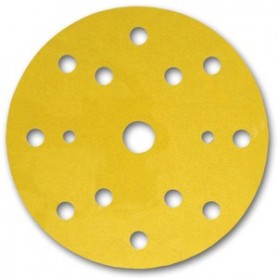
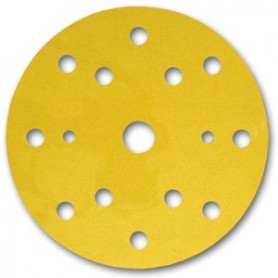
The hole pattern also matters. Discs with holes are designed to improve dust extraction, keep the surface cleaner, and extend the lifespan of the abrasive. For efficient extraction, the disc perforation must match the sander’s backing pad. If they do not align, dust extraction efficiency decreases and the work becomes less effective.
The fastening system is also important. Most discs use a hook-and-loop system (Hookit), which allows quick changes and secure attachment to the backing pad. Other systems, such as Roloc or shaft-mounted discs, are designed for specific tools and more localized work.