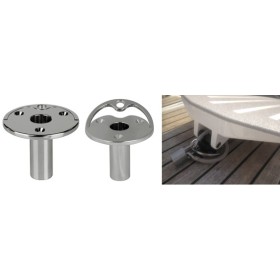
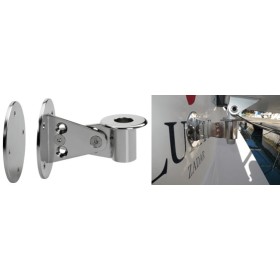
Available under demand
€2,907.42
€3,420.49

Boat gangways make it easier to access between the vessel and the dock, providing comfort and safety both in port and during extended stays on board. They are especially useful when there is a significant height difference or when you want to avoid climbing on and off in an uncomfortable or unsafe way. Choosing the right gangway improves mobility and reduces the risk of falls.
There are 30 products.
A gangway is more suitable than a ladder when a comfortable and stable access between the boat and the dock is required. It is especially recommended for moorings with pronounced height differences, variable tides, or when access is frequent, a common situation on yachts and large vessels.
Unlike a ladder, a gangway allows for natural walking, making it easier for people with reduced mobility, children, or when carrying objects. It is also a safer solution for long stays in port, where repeated use of a ladder can be uncomfortable or unsafe.
The length of the gangway must be adapted to the height of the dock and the boat’s freeboard, taking into account possible level variations due to tides or changes in load. A gangway that is too short will have an excessive incline, making passage difficult and increasing the risk of slipping.
As a reference, the greater the height difference, the longer the gangway should be to maintain a comfortable angle. On large vessels or yachts, with high freeboard or in ports with large tidal variations, it is preferable to opt for longer gangways that ensure stable access in any situation.
The safety of a gangway largely depends on its support and fixing systems. At the end resting on the dock, it is common to find wheels, non-slip pads, or articulated supports that allow it to adapt to the boat’s movement.
On the boat side, gangways are secured using specific brackets or reinforced anchor points that ensure stability under load. In addition, many feature non-slip surfaces and side handrails, elements that increase safety during passage, especially in wet conditions.
The gangways designed to take up the least space are folding or telescopic models. These allow their length to be reduced or folded onto themselves, making storage on deck, in lockers, or inside the boat easier.
They are especially recommended for vessels with limited space, as they combine functionality and ease of storage without sacrificing strength. Choosing a compact gangway improves on-board organization and avoids unnecessary obstacles when it is not in use.
There are also folding and telescopic gangways specifically designed for yachts, combining high load capacity with optimized storage solutions.