



Available under demand
€1,173.94
€1,304.38

Boat fenders are an essential element for protecting the hull during docking and mooring. Their function is to absorb impacts and rubbing against the dock, pontoons, or other vessels, preventing structural and cosmetic damage. Choosing the right size, type, and placement of fenders improves safety and extends the service life of the boat.
There are 212 products.
The boat’s displacement determines the amount of energy generated when the vessel comes into contact with the dock. The greater the weight, the greater the impact force and, therefore, the greater the fender’s required absorption capacity.
On lightweight vessels, smaller and more manageable fenders can be used, while on boats with greater displacement it is essential to opt for fenders with a larger diameter and volume. An undersized fender can compress excessively and lose effectiveness, leaving the hull exposed to direct impacts. For this reason, in addition to length, the boat’s actual weight is a key factor when correctly sizing fenders.
For this reason, the size and type of fender must be adapted not only to the length, but also to the displacement and the use of the boat, from tenders or recreational craft to larger vessels or professional-use boats.
The type of mooring influences the choice of fender. For side moorings along pontoons, tubular or cylindrical fenders are the most common, as they adapt well to the hull’s shape and provide continuous protection along the side.
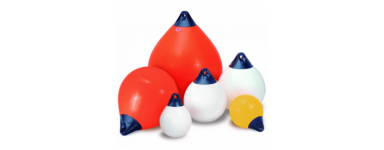
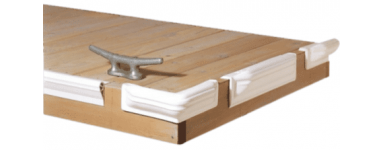
For bow or stern moorings, or when the boat is positioned between two others, spherical fenders provide greater absorption capacity at specific points. In permanent moorings or areas with significant tidal variation, flat or pontoon fenders are also used, designed to protect larger areas of the hull against constant rubbing.
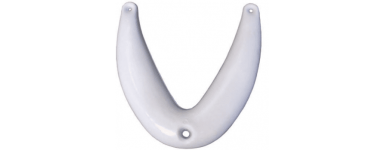
In addition, there are fenders designed for specific areas of the boat, such as bow fenders, flat or pontoon fenders, and semi-rigid or large-volume inflatable models, intended for permanent moorings, large vessels, or areas with higher exposure to impacts.
The materials used in marine fenders are designed to withstand pressure and recover their shape after impact. The most effective are:
- Flexible PVC, highly resistant, elastic, and durable in salty environments.
- High-density vinyl, with great absorption capacity and a long service life.
- Technical foams, used in fixed or flat fenders, ideal for continuous rubbing.
These materials allow the fender to compress on contact and return to its original shape, reducing the transmission of force to the hull.
Correct fender placement is just as important as their size. They should be positioned at the appropriate height, covering the waterline and the points of contact with the dock or pontoon.
It is advisable to distribute several fenders along the side rather than concentrating them in a single point. In this way, loads are evenly distributed and a specific area of the hull is prevented from bearing the full impact. Properly adjusting the height and spacing between fenders ensures effective protection under any mooring conditions.


